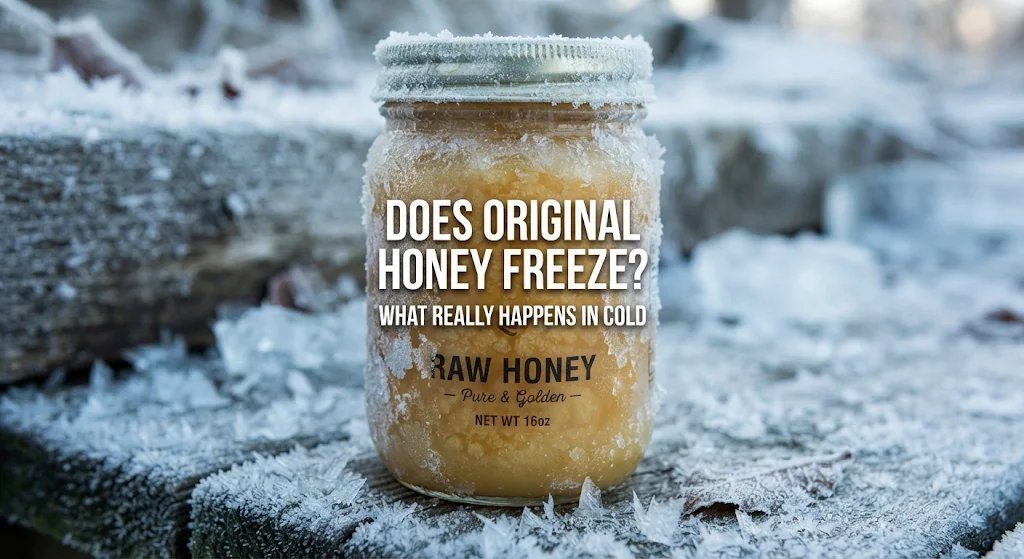
You may have heard that pure honey never freezes, and used it as a test of quality. So does original honey freeze, and is the claim true? The reality is more nuanced than the popular myth. This guide explains what really happens to honey in the cold and why freezing is not a reliable purity test.
Does original honey freeze solid?
Honey does not freeze solid at normal freezer temperatures the way water does. Its very low water content and high sugar level give it a very low freezing point. Instead of turning to ice, honey becomes thick, stiff and slow to pour. At deep-freeze temperatures it can set firm, but it does not form ordinary ice crystals.
Why honey thickens in the cold
Cold slows the movement of honey’s sugars, making it dense and sluggish. It may also crystallise faster, turning grainy and cloudy. This is a natural change, not a sign of spoilage or poor quality. Gentle warming returns it to a smooth, runny state.
The purity-test myth
Many people believe real honey will not freeze while fake honey will, but this is unreliable. Both pure and adulterated honey respond to cold in similar ways, depending on their sugar and water content. Freezing simply cannot tell you whether honey is genuine. For that, buy from trusted producers and check the label.
Key points to remember
- Honey thickens and may crystallise in the cold.
- It does not form true ice at freezer temperatures.
- Freezing is not a test of purity.
- Warm a stiff jar gently to restore it.
Storing honey the right way
How you keep honey matters more than whether it freezes. Our full guide on how to store honey explains the ideal conditions, and the JustHub blog has more pantry tips. For honey facts and quality, the National Honey Board is a trusted source.
Original honey thickens and crystallises in the cold rather than freezing like water, and that quirk says nothing about its purity.